Thursday, March 3, 2022

They don't make things like they used to...the Victoria & Albert Museum...

In considering which museum I would return to for a second glance, so far the Victoria & Albert Museum of Art and Design in London is in first place. What you see there is the kind of history and creative writer, as opposed to a historical writer, would be interested in. What did people wear? What did people make? What did they keep in their houses and what were their houses like? What did they serve food in? What were their beds like? You can't imagine how hard it can be to find this information compared to finding out what war was fought when and who conquered what. The Victoria and Albert Museum contains an incredible amount of artifacts from very old times before everything was mass manufactured, when things were beautifully, painstakingly made and made to last (and only affordable if you were SUPER rich.) Many of these items belonged to European royalty, or were worn by them, or given by them to somebody. 
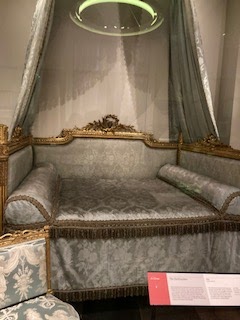
This is one of a few very old beds featured in the museum, back when the bed posts were carved into ornate shapes and everyone had a huge canopy, probably to keep bugs and rats from falling on you when you slept.
Boxes made of mother-of-pearl and gold...many of these were featured in the jewelry exhibit, which was probably my favorite part. Did you keep your dope in there? Probably.
The fashion exhibit was another favorite part. Here we see dresses from the era of the bustle. These were actually worn by women of the time and then gifted to the museum. By the way, people used to be TINY. I don't mean thin...I mean small, like children.
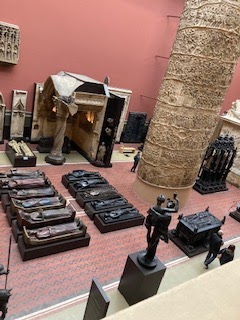
Another must see element of this museum are what's called the "cast courts." This is a massive hall filled with recreations of ancient sculptures and tombs from historical places around the world, such as Rome, Troy, etc...We actually didn't even get time to go in, so these photos were taken from above, but to get a sense of the size...see the actual person standing by the pillar there?
See the recreation of David there? I am about the size of his lower leg.
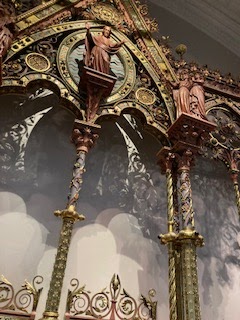
Another cool thing in this museum were the recreations of whole actual rooms, in which they replanted actual ceilings and walls from room of great properties of various eras. This was in the ceiling of a 18th century "music room."
Another 18th century room.
Many artifacts featured once belonged to the Church, including some very ornate objects made of very expensive materials.
There were also lots of bedazzled swords, and even some crossbows as seen here.

Many of these fans were made of ivory at the handle, and you have to look closely to appreciate the details. No 3-D printers or lasers in the 17th century!


Another from the jewelry exhibit...a pendant featuring lily of the valley...my birth flower.
This is one of several embroidery squares made by Mary Queen of Scots...it features a monkey. A lot of them featured exotic animals for some reason.
Here's the woman herself. There were also a lot of trinkets worn by or given by her famous relative Elizabeth I, of whom you may have heard.
Apparently this was a trend for a time...shadowboxes featuring the experience of death...this one is a soul in Purgatory.
SOOOO much silver. This is a teapot that again, you have to see closer to appreciate. Who cleans it??? (Danielle and I noted that is what our moms would ask.)
A vanity with more cool stuff reflected in the mirror. This kind of thing just can't be found anymore. Nor could any of us afford it. But imagine featuring it in a story.

Note for teachers: This is a must stop for Encounters, and certainly it raises questions about the way mass production has changed art, as well as the role of domesticity in inspiring art. I made it a required visit for my Women Writers students, but for the purpose of thinking about the domestic sphere and the relationship to women's writing, there's a place called the Museum of the Home, in the Shoreditch area, which might be more appropriate.

Sunday, February 27, 2022

Day Trip One: Salisbury and Stonehenge

Our first day trip in London Study Abroad with DMACC took us to Stonehenge followed by a trip to the lovely town of Salisbury a couple of hours west of London. Highly recommended, not only for Stonehenge itself and the beautiful Salisbury Cathedral you see below, but for the town. Great shopping and great dining. It rests on the Avon, too, which adds to the scenic beauty of the place.
Here's a long and close view of Stonehenge itself, which is about 5000 years old. They have no idea what it really is or what purpose it served. There are many theories, including something to do with aliens, but what they do figure is it would have taken 1000 men to move the major stones from miles away, so it must have been important. 
It was a gorgeous day fortunately too, with a rare blue sky. My favorite part here was the ravens, though they were often too quick to get a photo. There is one perched on the stone here though if you look really closely.


Here see the interior of Salisbury Cathedral...including some pretty spectacular stained glass, some of which was the original.
The cathedral was full of amazing displays like this...again, you have to look really closely to appreciate the level of detail. Also found in the Cathedral is an original 1215 Magna Carta.
Here is the exterior of the cathedral from a distance. We took a lovely walk around the area of the cathedral with our tour guide and view some of the very old and very lovely (and very expensive) properties around. Lots of pretty flowers starting too...in February! 
The cathedral was full of tombs like the one you see here...chances are wherever you strolled you were walking on dead people of note. The tombs feature the dress of the time the dead person lived, and they were often depicted as skeletal. Hardcore goth! (Literally, most of the architecture was Gothic.)

Another great exterior view...this cathedral only took 38 years to make when most like it took at least a hundred. Wool money, apparently. Wool is still a thing in this area...lots of sheep to be seen from our coach on the way.


And finally, here's a swan we saw swimming in the Avon. It was huge. Ravens were huge too, as were pigeons we found. Why are birds larger in England? Might be worth a Google.

Just a little bit of modern art...and a very non-modern theater.

Our second week in London, my students and I took the opportunity to visit Tate Modern, a gigantic museum of modern art in London. The next day, we visited Shakespeare's Globe Theatre, which is in the same area along the Thames, but represents the sort of opposite end of the aesthetic spectrum I suppose. These were great visits, because the views from the bridges over the Thames are amazing, first of all. I highly recommend the newest bridge - the Millennium Bridge - which is fully pedestrian and features fantastic views of the Tower Bridge and all the other great structures along the river. London's Borough Market is also within walking distance, and that is definitely a place I would visit again.


See above a massive textile installation by Cecilia Vicuna, an poet-artist I've come to appreciate in the past. These red fabric ropes went all the way to the ceiling in a huge room, to give you a sense of the scale. There were many larger than life sculptures at the Tate, which like the British Museum, is way to big to take in unless you give yourself a day.

The exterior of the Tate is an example of the beautiful modern architecture you can find in London, in addition to the many gorgeous older examples.
This is a massive tower made of radios. The oldest versions of radios make up the bottom, and as you go higher, the versions become more recent.
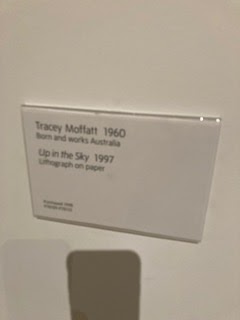
I am actually not a huge fan of modern art if I'm being honest, but plenty of exhibits did strike me, including this photography exhibit in a collection devoted to Australia by Tracey Moffatt.
These photos were really incredible...there was such a feeling of movement and drama. Very emotionally charged.

Note for teachers: This is a must for Encounters, but you have to stress that they should try hard to engage with art that isn't necessarily a picture of something. Pose questions about the value and purpose of abstract art, reminding them that just because it looks like a mess, doesn't mean it was as easy to make.


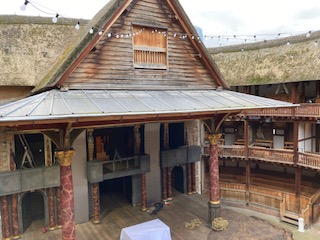
This is the exterior of Shakespeare's Globe Theatre on the Thames. The original Globe burned long ago, but this is an authentic reconstruction, made with virtually all the same materials and mostly the same design (with modern accessibility and safety features added.) It was also moved from the original location, which was just around the corner.
This is a view from the upper level...you can see it is an open-air theater. It has a thatched roof, for which they had to obtain special permission due to fire safety laws. There are sprinklers installed on the roof which need frequent testing, hence the need to scrape off moss now and then.
You have to examine more closely to appreciate the detail here as well. This was made in the exact design and with the exact materials that would have been used in Shakespeare's time, which is pretty amazing.

This is a view from the lower level, in which you can see the stage. The seats are all just open wood benches, and there is a standing area in front that would have been the penny seats. Usually the stage doesn't extend out like this, but they did it for a youth production of MacBeth (which Dan and I would see as well just for the experience.)


Weird London

Though I have shared most of my excursions with students, there are trips I took by myself or with my awesome colleague, Danielle Galien, a Criminal Justice instructor who came with me (thank the gods.) One of these was the Viktor Wynd Museum of Curiosities, Fine Art and (Un)Natural History. which I discovered thanks to Atlas Obscura. Danielle and I took a trip into a not-so-great area of London for this, and it was well worth it. I've never been to a curiosity shop, but there are a number of them in London, and its always been interesting to me. Not for the faint of heart though, and probably not one to visit with students, although I hope they check it out at some point on their own. It was hard deciding which photos to share, I can tell you that. The Victorian hair sculptures aren't here, nor are the early depictions of monks having sex with nuns - but I hope you enjoy what's here. After, Danielle and I hit the bar to try some absinthe, which I haven't drunk since I lived in Ohio, and Danielle had never tried at all. It's worth the experience, but not recommended for daily consumption. In terms of taste, think in terms of black licorice mixed with dust.

At the door, we were assured there were no prostitutes to be found here, which is good I suppose. Whoever put this collection together was a particular fan of shadow box displays featuring stuffed rodents, as in the Moltar you see here...
Also to be found were remains of monstrous creatures, very realistically constructed, such as the lagoon creature head you see here, and a mermaid or two, and the leg bone of an Irish giant found in a lake somewhere...
The museum featured a lot of collected poo in jars, which Danielle admitted attracted her to the site. (Forensic investigators, right?) This is a jar of Kylie Minogue's poo supposedly, and there was poo from all manner of semi-famous people, and a jar of Russell Crowe's pee as well. Russell Brand also donated a jar of his pubes, which was nice of him.
These are frogs.

Teacher's note: If your students are mature enough, I think there is potential here for all manner of creative writing prompts. One might ask students to choose one of these artifacts and describe it, or to describe the environment. Another would ask them to write a scene in which the main character works at, owns, or founded this strange place. A third might choose one of these articles and attempt to tell the story behind it using only scene and detail. Finally, I would love to see students invent their own curiosity shop or curiosity cabinet and fill it with objects they imagine themselves in the spirit of a place like this.

Two museums: one colossal and one delightfully diminutive...

Our first week my students and I hit what I would consider to be two must-see stops while in London: the British Museum, which is colossal and requires at least a day to view (we were a little rushed, so I will probably need to go back there) and the Sherlock Holmes Museum...much smaller but also very worth the visit. Obviously, my Detective Fiction students were required to hit that one.

I'll start with Sherlock, mainly because we got a lot of photos and were encouraged to take them. There was an audio guide leading patrons through the tiny little museum, and we were greeted by an old English bobby at the door and a Victorian-era dressed chamber maid led us through the displays. In addition to lovely displays of what could have been Sherlock's 19th century home on 221b Baker Street, there were wax figures representing characters in Sir Arthur Conan Doyle's stories, including this very creepy victim from "The Adventure of the Speckled Band."

Sherlock's study was full of authentic Victorian artifacts: furniture, glass vials, and numerous other antiques very beautifully kept and preserved. While the museum is obviously a commemoration of the Holmes character, it is also creates a great comprehensive picture of Victorian English home living.
This guy is the Hound of the Baskervilles of course.
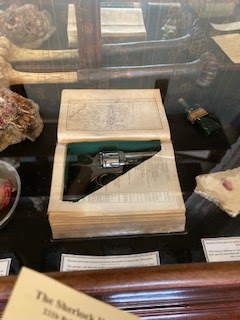
We see Sherlock's gun... but what don't we see! I looked everywhere for the box where the character would have kept his opium and coke...not to be seen. It's interesting what a museum does and doesn't reveal!

Note for teachers: A museum exhibit is also a text, and like the mysteries and detective stories we read, students can analyze what is revealed and what isn't, as well as what stories the details tell us.
You have to really examine these photos closely to see the level of detail...pretty awesome.
And here is where Sherlock shot up the wall with his gun one day. The pipe collection is right below.
As for the British museum...not sure we were really supposed to take photos. (I took a bunch.) What struck me most of all was not only the amount of artifacts taken from their home nations, but the incredible scale of what is kept there. This is from the Egyptian exhibit, and the photo might not allow for an appreciation of how huge these statues are. At a museum in the States, such as the Field Museum of Natural History in Chicago, you might see a mummy or two...but when you think the British Museum, don't think a dusty old corpse. Think a whole city ...that's the size of what you could see there. Full walls...entire tombs bigger than your living room. Something to think about.

Note for teachers: Encounters students should choose a region or historical era and use what they see in the museum to analyze the aesthetic and artistic values represented. Obviously, there are plenty of questions you might pose as a teacher of post-colonial studies, literature and otherwise.

The British Library is built to look like a boat...

 Our first week in London was somewhat of a whirlwind, which is perfect for alleviating jetlag I suppose. No time to fall into a nap when the town is waiting. Our fantastic British Life and Culture instructor Nicole Moody took us on a surprise trip to the British Library not far from King's Cross station, which saved me from planning a trip with my Encounters in Humanities students (and from taking an ill-advised nap.) 

This is St. Pancras outside King's Cross station...a hotel now but maybe not one I can afford. It is another example of beautiful architecture you can find all over London though, which we have to appreciate as residents of Midwest suburbs. Certainly the Brits are proud of it for good reason.


Here see King's Cross station itself...a major travel hub, from which myself and my students will travel to the continent via Eurostar...

The British Library for instance, has been rebuilt to look like a boat as you can see here. This isn't the original building in which the collections were housed, but I have to say I find this redesign pretty adorable. 

People do actually sit around and study in this library, too, which surprised me. In the area, and in many areas around London, you would also notice numerous temporary installments of modern art, such as this giant illuminated bird cage, in which you can sit on a swing like a canary. For Encounters in Humanities, you could probably book a tour of these sites.
My students were to observe the free collection in the library, as I did too. I saw original notebooks by the Brontes and Virginia Woolf, and even Angela Carter, which I didn't expect. They had a copy of The Girlhood of Shakespeare's Heroines as well - my mom gave me a copy of that long ago that sits on my shelf, so that made me feel special. But I was also pleased to see a lot of emphasis on books as works of art, and the acknowledgement of a tradition that began with some of the oldest religious texts. Those tended to be my favorite...very beautiful.

Notes for teachers: This is definitely a good stop for Encounters in Humanities. If you wanted to get specific, you might provide a prompt that asks students to discuss the intersections between text and art highlighted by the collection. This might be a good stop for Women Writers as well, if just for memorial reasons. If you incorporate a book-making element into your creative writing, this would be a must.

Saturday, February 26, 2022

Arriving in London and Diving In

We arrived in London after a somewhat challenging flight experience, in which some of us had to change flights abruptly and others had our bags delayed...but we made it, and it all worked out. The weather wasn't awesome for our sightseeing tour, but we got a good look at Buckingham Palace and a feel for the city. There was a photo op along the Thames and some great views there, so high hopes all around! So far the students have done marvelously adjusting to their home stays, using the tube and getting to class on time...keep fingers crossed!

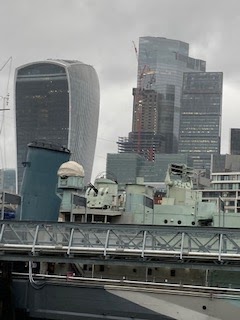
Below see Tower Bridge and a view of London from the Thames...


This is the HMS Belfast...you can take a tour inside if you want.
The weather was typical for London this time of year, so the photos out the window weren't great, but I thought a couple were at least worth posting, including the red phone booth and a rain-droppy Big Ben...


Here we arrived at Buckingham Palace and got some photos of the palace and the fountain as well as the guard. I think students liked this a lot despite the rain...


Here too find a pic of us at the airport, narrowly avoiding disaster. The students' attitudes were great, though. Here see my homestay...a nice little place on Salisbury Road in Ealing, which is a cool little neighborhood right off the Piccadilly line. 

Wish I had time to write more, because there is a lot to talk about! We are definitely keeping busy!